Advent vs. Christmas: What's the Difference and Why It Matters
By the second week of December, most of us have already heard "Silent Night" a dozen times, hung a wreath on the door, and bought at least one gift we are not entirely sure about. Christmas feels like it is in full swing. Then a church announces the first Sunday of Advent, and someone asks the fair question: isn't that just the church word for the Christmas season?
No. Advent and Christmas are two different seasons with two different jobs, and the church kept them apart for centuries. Knowing the difference does not make December more complicated. It tends to make it holier, and strangely, more joyful.
Two seasons, two postures
Advent runs for the four Sundays before Christmas, beginning on the Sunday that falls on or closest to November 30. Christmas begins on December 25 and, in traditional church calendars, lasts twelve days, ending at Epiphany on January 6.
The postures differ, and that is the whole point. Advent looks forward. Christmas celebrates. Advent is minor-key and lean; Christmas is full-voiced and abundant. Advent prays, "Come." Christmas announces, "He has come."
The commercial calendar flattens both. Retail celebrates for six weeks and then stops cold on December 26, while the church has only just begun. Anyone who has felt the odd emptiness of December 27 knows the problem: we spend the season of waiting on a party, and then have nothing left for the feast.
Where Advent came from
Nothing in Scripture commands four candles or a purple stole. Like Lent, Advent grew over time as a practical response to how Christians wanted to prepare.
Historians trace early forms to fourth-century Gaul and Spain, where a period of preparation preceded Epiphany baptisms and the celebration of Christ's birth. In some regions it lasted forty days, mirroring Lent, which is why Advent is still occasionally called a "little Lent." Eastern churches never shortened the fast; the Nativity Fast, sometimes called Philip's Fast, begins November 15 and runs forty days. Western churches eventually settled on four Sundays.
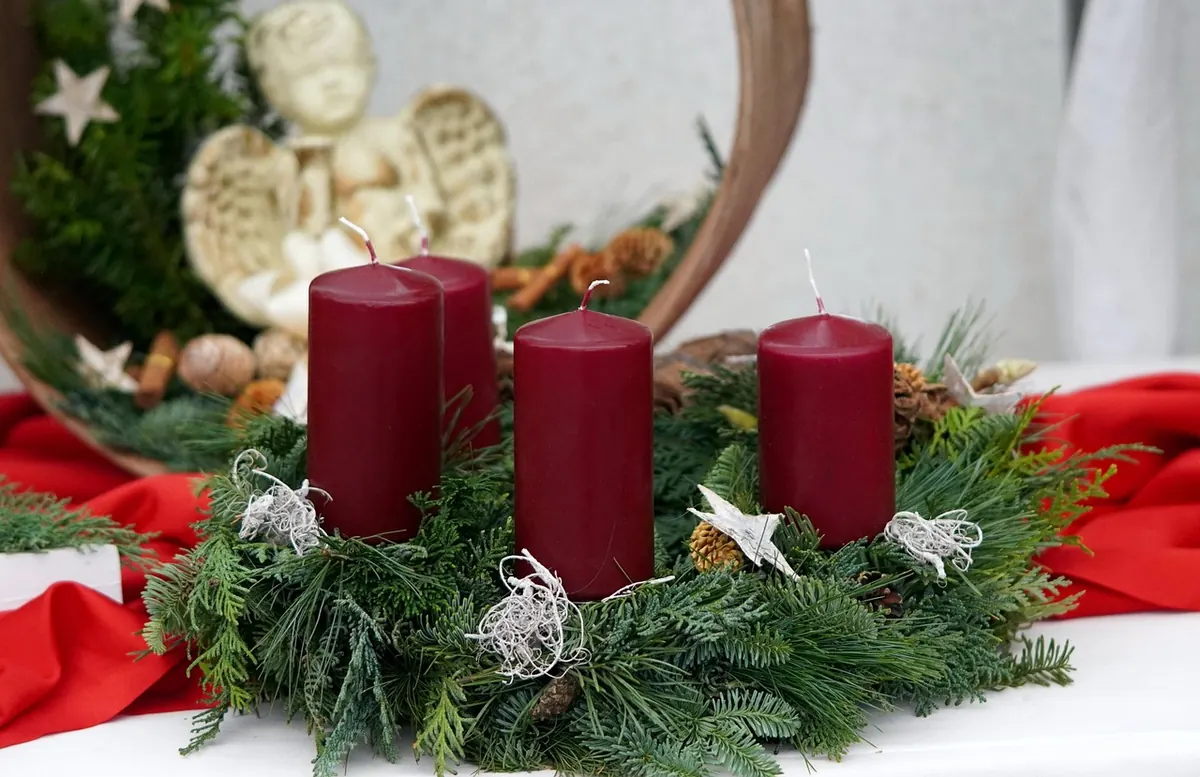
Two symbols held on. The liturgical color is purple, for penitence and royalty, or blue, for hope and expectancy; many churches use a rose candle on the third Sunday, Gaudete Sunday, as a mid-season note of joy. The wreath itself came later, moving from the home into the sanctuary. Its evergreens form a circle with no beginning and no end, and its candles burn brighter each week as Christmas approaches.
What Advent is not
- Not anti-Christmas. Nobody is asking you to skip the carols or the cookies. Advent exists to make Christmas mean something when it arrives.
- Not a second Christmas with different songs. Advent hymns — "O Come, O Come, Emmanuel," "Come, Thou Long-Expected Jesus" — are prayers of longing, not celebration anthems.
- Not a required observance. You will not find it in the Ten Commandments. Treat it as a tool, not a test.
- Not a competition. If your neighbor's family does a Jesse tree, a daily reading, and handmade candles, that is lovely. Your one candle at dinner is also lovely.
The wreath and the four words
The familiar themes of hope, peace, joy, and love are a modern devotional framework, not an ancient rule, and congregations label the candles in different orders or skip labels entirely. Use them if they help; the symbolism does not depend on them.
What does the work is the repetition. Lighting a candle at dinner, reading four verses, and praying one sentence — that small ritual does something a month of scrolling cannot. It teaches a household to want something before it gets it.
Why the distinction still matters
Longing is what makes joy legible. Hand a gift to someone who has not wanted it and you get a shrug. Hand it to someone who has been waiting, and you get tears. Advent does the slow work of building desire, so that December 25 lands on a heart that has been stretched to receive it.
Waiting is also a spiritual skill, and it is one most of us are out of practice at. Israel waited. Simeon and Anna waited in the temple for a consolation they might not live to see. Their waiting was not passive; it was expectant, watchful, prayerful. Advent gives us four weeks a year to practice the same posture.
And Advent keeps the second coming in view. The season is not only about a manger in Bethlehem; it is about a King who promised to return. That double focus gives honest language to anyone whose December is hard — who is grieving, or sick, or estranged from family. The ancient prayer of the season is not "make everything festive." It is this:
"He who testifies to these things says, 'Surely I am coming soon.' Amen. Come, Lord Jesus!" (Revelation 22:20)
That prayer is for the joyful and the exhausted alike.
How to keep Advent without losing Christmas
You do not need to overhaul your December. Pick one or two of these and let the rest go.
- Set a wreath on the table and light it at dinner. One candle the first week, two the second, and so on. Read a short passage, pray a sentence, blow it out. Five minutes.
- Hold Christmas carols until Christmas Eve. Sing Advent hymns in the car instead. It sounds severe; it is not. The carols hit harder when you have waited for them.
- Try a Jesse tree. A daily reading traces the family line of Jesus from creation to the manger. It takes ten minutes and gives children a storyline instead of a countdown.
- Choose a small fast and a small generosity. Skip one thing you enjoy and give the money or the time to someone who needs it. The two practices belong together.
- Delay one celebration. Save a gathering, a special meal, or the last of the decorating for the week after Christmas. Let the feast actually be a feast.
- Keep the tree up through Epiphany. If that feels like too much, keep just the lights. The point is that Christmas starts on the 25th, not ends there.
If you have children
Children take to Advent quickly because it is tangible: candles, a calendar, a paper chain, an empty manger that gets a piece of straw for each kind act. Keep it short and let them light the match. The memory they carry will be the ritual, not the explanation.
If the season is heavy this year
Advent is a good season for grief because it does not demand cheer. Let the first candle be a place to say out loud what you are waiting for. Hope in Scripture is not optimism; it is confidence that God will finish what he started. If your sorrow is deep or persistent, talk with a pastor, a counselor, or a trusted physician — that is wisdom, not a lack of faith.
Start with one thing this year
Advent is not a burden to add to an already crowded month. It is a fence around four weeks of waiting, built so that Christmas can arrive as good news rather than as a deadline. So choose one practice. One candle. One hymn. One sentence of prayer repeated each night: Come, Lord Jesus.
Then let Christmas come, and last, and be what it was always meant to be.
Photo: matthiasboeckel / Pixabay
How to Fast Safely as a Christian: A Beginner's Guide to Biblical Fasting
Fasting is a normal part of Christian devotion, but it needs care. Here is how to choose a fast, prepare...

How to Talk About Faith at Work Without Being That Person
A practical guide to sharing faith at work with listening, good timing, legal awareness, and habits that...
About Us